
TL;DR The recent FBI-led disruption of SocGholish malware is a reminder that many ransomware attacks begin with a simple user action. SocGholish malware spreads through fake browser update prompts on compromised websites, giving attackers a foothold inside business networks. Strong security awareness training, least-privilege access, and managed cybersecurity services can significantly reduce the risk.
Many business owners assume ransomware begins with a sophisticated attack against their network. In reality, some attacks start with something much simpler: a user visiting a legitimate website that has been compromised.
That is exactly how SocGholish malware operates.
In June 2026, international law enforcement agencies announced a major disruption of the SocGholish infrastructure as part of Operation Endgame. The operation resulted in the takedown of servers and domains used to distribute malware and the remediation of thousands of compromised websites.
While the law enforcement action is significant, the bigger lesson for businesses is understanding how these attacks happen in the first place.
What Is SocGholish Malware?
SocGholish, also known as FakeUpdates, is a malware delivery framework that has been active since at least 2018.
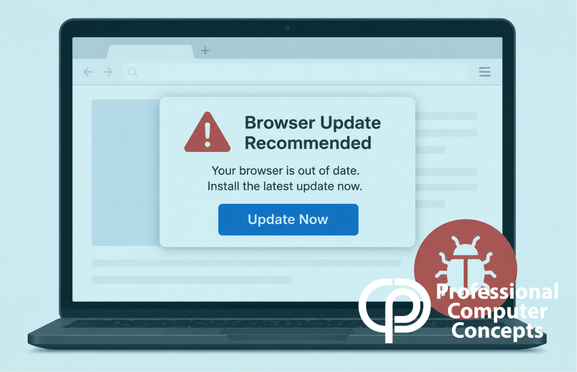
Unlike traditional phishing attacks that rely on emails, SocGholish typically infects victims through compromised websites. When a user visits an affected site, they may see a message claiming their browser requires an update.
The prompt often appears legitimate and may mimic updates for Chrome, Edge, Firefox, or other commonly used software.
If the user downloads and runs the file, the malware gains an initial foothold on the device.
From there, attackers can deploy additional tools, steal credentials, move laterally through the network, or ultimately launch ransomware attacks.
Why SocGholish Matters to Small Businesses
Small and midsize businesses often assume cybercriminals only target large enterprises.
That assumption can be costly.
SocGholish campaigns are frequently opportunistic. Attackers are less concerned with who visits the compromised website and more interested in identifying organizations that can later be monetized through ransomware, credential theft, or business email compromise.
For many organizations, a single infected workstation can provide enough access for attackers to begin exploring the environment.
This is one reason why cybersecurity is no longer just an IT issue. It is a business risk issue.
How Fake Browser Updates Fool Employees
One reason SocGholish has remained effective is that it exploits normal user behavior.
Employees regularly receive legitimate software updates. Most have been trained that keeping software current is important.
Attackers take advantage of that expectation.
A fake update prompt may appear while an employee is researching a vendor, checking industry news, reviewing permit information, or simply browsing the web.
The employee believes they are doing the right thing by updating software and unknowingly installs malware instead.
The Safer Approach
Businesses should establish a clear rule:
Software updates should come from:
- The operating system
- The browser itself
- Managed IT tools
- Approved software deployment processes
Employees should never install software from website pop-ups.
Did You Know?
According to Verizon’s 2025 Data Breach Investigations Report, human involvement continues to play a significant role in security incidents, reinforcing the importance of user awareness and security training. Source: Verizon DBIR
The Role of Least Privilege in Limiting Damage
Even with strong user training, mistakes can happen.
That is why security controls matter.
The Principle of Least Privilege limits users to only the access necessary to perform their jobs. If malware infects a workstation, attackers encounter fewer opportunities to access sensitive systems or spread throughout the network.
Read more in PCC’s article on The Principle of Least Privilege and Why It Matters for Cybersecurity.
When organizations combine least-privilege access with modern endpoint protection, they create multiple layers of defense against threats like SocGholish.
Why Security Awareness Training Still Matters
Technology alone cannot stop every attack.
Employees remain one of the most important security controls in any organization.
Effective security awareness training helps employees recognize:
- Fake software updates
- Phishing emails
- Credential theft attempts
- Social engineering tactics
- Suspicious downloads
The goal is not perfection.
The goal is reducing the likelihood that a single mistake becomes a business-wide incident.
For additional reading, explore:
- The Small Business Guide to Cybersecurity
- Shadow AI Risks Every Business Should Understand
- The Principle of Least Privilege and Why It Matters for Cybersecurity
What Businesses Should Do Next
The FBI’s disruption of SocGholish infrastructure is good news, but it does not eliminate the underlying threat.
Criminal groups continuously adapt their tactics. New malware families and delivery methods will continue to emerge.
Businesses should focus on fundamentals:
- Keep systems patched
- Restrict administrative privileges
- Deploy endpoint detection and response tools
- Provide ongoing security awareness training
- Monitor for suspicious activity
- Maintain tested backups
Organizations that consistently execute these basics are significantly more resilient than those that rely on a single security tool.
About Professional Computer Concepts
Professional Computer Concepts (PCC) is a trusted Managed IT and Cybersecurity provider serving the Bay Area for over 20 years. We help small and midsize businesses simplify their IT, strengthen security, and modernize operations.
Explore our services:
Managed IT Services | Cybersecurity Services | Cloud Solutions
FAQ
Is SocGholish malware a virus?
SocGholish is generally considered a malware delivery framework. Its primary purpose is to establish initial access so attackers can deploy additional malicious tools.
How does SocGholish infect computers?
SocGholish commonly infects devices through fake browser update prompts displayed on compromised websites.
Can antivirus software stop SocGholish?
Modern endpoint protection may detect and block many variants, but no security tool is perfect. User awareness and layered security controls remain essential.
Why are fake browser updates dangerous?
They can trick users into installing malicious software that provides attackers with access to business systems and data.
Are small businesses targeted by SocGholish?
Yes. Small businesses are frequently targeted because attackers often look for organizations with weaker security controls and limited monitoring capabilities.
From PCC’s Desk
Most successful cyberattacks do not begin with sophisticated hacking. They begin with ordinary people encountering ordinary situations and making understandable mistakes.
The lesson from the SocGholish malware takedown is simple: strong cybersecurity starts with good habits, layered defenses, and informed users.
If you’d like help evaluating your organization’s cybersecurity posture, Let’s Talk.