
TL;DR Third-party access security risks are often overlooked until something goes wrong. The ADT data breach serves as a reminder that businesses should regularly review who has access to their systems, data, and facilities, and ensure those permissions are properly controlled.
Most organizations spend significant time protecting their own employees’ access to business systems.
Far fewer spend the same amount of time evaluating vendors, contractors, consultants, software providers, and former employees who may still have access to company resources.
The 2026 ADT data breach is a useful reminder that cybersecurity is not just about protecting your network. It is also about understanding who has access, why they have access, and whether they still need it.
For small and midsize businesses, third-party access security risks can create vulnerabilities that often go unnoticed until after an incident occurs.
What Happened in the ADT Data Breach?
According to public reports, ADT disclosed a data breach involving unauthorized access to customer information through a third-party business partner relationship.
While the details continue to be reviewed, the incident highlights an important reality: your organization’s security is often influenced by the security practices of external partners.
Businesses routinely grant outside organizations access to:
- Customer information
- Building systems
- Cloud applications
- Remote support tools
- Security systems
- Financial systems
Every additional connection increases the organization’s attack surface.
The question is not whether third-party access is necessary. In many cases it absolutely is.
The question is whether that access is being managed appropriately.
What Are Third-Party Access Security Risks?
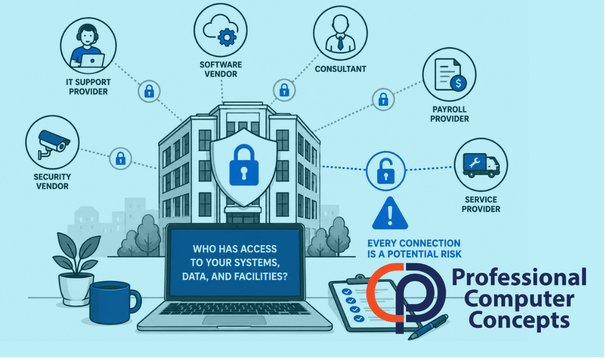
Third-party access security risks arise whenever an external organization or individual is granted access to company systems, applications, facilities, or data.
Examples include:
- IT service providers
- Security vendors
- Payroll companies
- Accountants
- Consultants
- Software vendors
- Contractors
- Temporary employees
These relationships help businesses operate efficiently.
However, they also create additional pathways that attackers may attempt to exploit.
Why Third-Party Access Matters
Many organizations have strong controls for employees.
They may require:
- Multifactor authentication
- Security awareness training
- Password policies
- Device management
Unfortunately, third-party accounts sometimes receive less oversight.
Over time, access may be granted, forgotten, and never reviewed again.
This creates opportunities for unauthorized access and security incidents.
The Hidden Risk of “Temporary” Access
One of the most common security issues involves access that was intended to be temporary.
Examples include:
- A consultant who completed a project years ago
- A former vendor relationship
- A contractor account that was never disabled
- Shared credentials that continue to exist
These accounts often remain active because nobody owns the responsibility of reviewing them.
The longer they remain in place, the greater the risk.
Why Small Businesses Are Especially Vulnerable
Large enterprises often have dedicated teams focused on identity management and vendor governance.
Small businesses typically do not.
As a result, access reviews may be informal or happen only when a problem occurs.
Many organizations cannot immediately answer questions such as:
- Which vendors have access to our systems?
- What permissions do they have?
- When was the last time access was reviewed?
- Are former vendors still able to log in?
If those questions are difficult to answer, there may be hidden risk.
Did You Know?
According to Verizon’s 2025 Data Breach Investigations Report, credential abuse and unauthorized access remain common factors in security incidents. Organizations must consider both internal and external access pathways when evaluating risk. Source: Verizon DBIR.
How Businesses Can Reduce Third-Party Access Security Risks
The goal is not to eliminate third-party relationships.
The goal is to manage them responsibly.
Review Vendor Access Regularly
Organizations should periodically review:
- Vendor accounts
- Administrative permissions
- Remote access tools
- Shared accounts
Access that is no longer needed should be removed promptly.
Follow the Principle of Least Privilege
Users should receive only the access required to perform their job.
The same principle applies to vendors.
If a contractor only needs access to one application, they should not receive broader permissions.
Learn more about the principle of least privilege in Principle of Least Privilege: A Practical Cybersecurity Guide for Small Businesses
Require Multifactor Authentication
MFA should be required whenever possible for both employees and third-party users.
This significantly reduces the likelihood of account compromise.
Disable Access When Relationships End
Vendor offboarding should be treated with the same importance as employee offboarding.
When a relationship ends, access should be reviewed and removed immediately.
Monitor Administrative Accounts
Administrative accounts deserve special attention because they often provide elevated access to critical systems.
Organizations should know:
- Who has administrative rights
- Why they have them
- When those permissions were last reviewed
What Questions Should Business Owners Ask?
The ADT incident provides a useful opportunity for business leaders to evaluate their own environment.
Ask yourself:
- How many vendors have access to our systems?
- Are all those relationships still active?
- Do we know exactly what permissions they have?
- Are we reviewing access regularly?
- Do we require MFA for third-party users?
Many organizations discover opportunities for improvement simply by performing this exercise.
How Managed IT Services Help Control Third-Party Risk
Managing user accounts, permissions, and vendor access can become complex as organizations grow.
A managed IT provider can help businesses:
- Review user permissions
- Audit vendor access
- Implement MFA
- Monitor administrative accounts
- Improve identity management
- Establish access review procedures
Read more in The Small Business Guide to Cybersecurity.
Learn how Managed IT Support Services can help strengthen security and reduce operational risk.
Explore Building Cyber Resilience in an Unstable World for additional cybersecurity best practices.
Frequently Asked Questions
What is third-party access?
Third-party access refers to any access granted to external individuals or organizations, including vendors, contractors, consultants, and service providers.
Why are third-party accounts risky?
Third-party accounts create additional entry points into an organization’s systems and may not always receive the same level of oversight as employee accounts.
How often should vendor access be reviewed?
Most organizations should review vendor access at least annually, with higher-risk systems reviewed more frequently.
What is the principle of least privilege?
The principle of least privilege means granting users only the minimum level of access necessary to perform their responsibilities.
Should vendors use multifactor authentication?
Yes. MFA should be required whenever possible for both employees and third-party users.
About Professional Computer Concepts
Professional Computer Concepts (PCC) is a trusted Managed IT and Cybersecurity provider serving the Bay Area for over 20 years. We help small and midsize businesses simplify their IT, strengthen security, and modernize operations.
Explore our services:
Managed IT Services | Cybersecurity | Cloud Solutions
From PCC’s Desk
Many security incidents begin with an account, connection, or permission that nobody remembered existed. The ADT breach serves as a reminder that cybersecurity extends beyond your employees and internal systems. Understanding who has access to your environment and regularly reviewing those permissions can significantly reduce risk.
If you’d like help evaluating user access, vendor permissions, or overall cybersecurity readiness, let’s talk.