
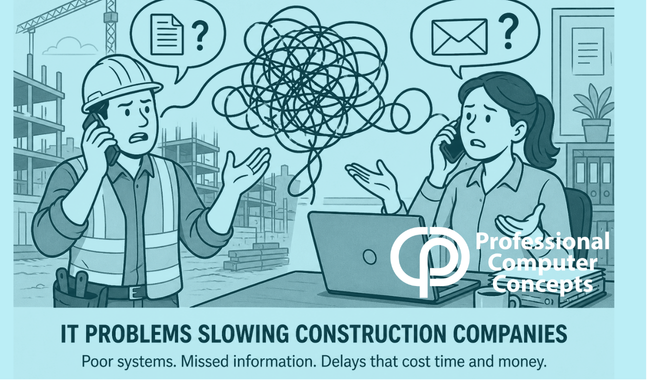
IT problems slowing construction companies aren’t always obvious.
Most don’t show up as outages or major failures. They show up as delays, repeated work, and constant small frustrations that quietly slow everything down.
At first, it feels manageable. Then growth starts to expose the cracks.
Why IT Problems Show Up as “Operational Issues”
Construction companies don’t usually think of inefficiency as an IT issue.
It looks like:
- Teams waiting on information
- Files that aren’t where they should be
- Communication breakdowns between office and field
- Duplicate work that shouldn’t exist
So, the assumption becomes:
“This is just how construction works.”
It’s not.
In many cases, these are early signs that your systems—and the way they’re being used—aren’t keeping up with how your business operates.
The Real Cost of Small IT Problems
Individually, these issues seem minor.
But they stack.
A delay here. A missed update there. A file that has to be recreated. A question that requires three calls to answer.
Over time, this leads to:
- Slower project timelines
- Increased labor costs
- Frustrated teams
- Reduced capacity to take on new work
And unlike a major outage, these losses are hard to measure. Which makes them easy to ignore.
Until growth stalls.
Where This Starts to Break Down
Most growing construction companies reach a point where:
- The number of projects increases
- More people are involved in each job
- Communication becomes more complex
- Expectations around speed and accuracy increase
But the underlying systems stay the same.
That mismatch is where problems begin.
In many cases, companies are still relying on:
- Shared drives with inconsistent structure
- Email chains as the source of truth
- Manual processes that depend on specific people
This creates the same kind of risk seen in other areas of the business.
If you’ve already seen how Business Email Compromise can exploit gaps in communication, the operational side follows a similar pattern—just without the immediate financial hit.
The “Workaround Culture” Problem
Instead of fixing systems, teams adapt.
They:
- Create their own tracking methods
- Store files locally
- Rely on memory instead of process
It works—until someone is out, something is missed, or the volume increases beyond what those workarounds can handle.
At that point, things don’t just slow down. They start to break.
This is the same underlying issue discussed here:
→ Process Failure Is the Real Cybersecurity Risk in Construction Companies
Why This Gets Worse as You Grow
Growth amplifies inefficiency.
More projects mean:
- More data
- More communication
- More dependency between teams
If your systems aren’t structured to support that, every new project adds friction.
Eventually, the business hits a ceiling:
- You can’t move faster
- You can’t take on more work without stress
- Leadership spends more time solving internal problems than focusing on growth
What Actually Fixes It
This isn’t about adding more tools.
Most construction companies already have:
- Microsoft 365
- File storage
- Basic security tools
The issue is:
- Lack of standardization
- No clear ownership of systems
- No structure around how information flows
Fixing this means:
- Defining how projects are organized digitally
- Standardizing file structures and access
- Aligning communication tools with how teams actually work
- Reducing reliance on manual processes
This is where IT shifts from support to strategy.
Final Thoughts
IT problems slowing construction companies aren’t usually caused by one big failure.
They’re caused by systems that were “good enough” at one stage of growth—but no longer are.
At Professional Computer Concepts, we work with construction companies that don’t just want things to “keep working.” They want systems that support how their business actually operates as it grows.
If your team is spending more time working around systems than using them, it’s worth taking a closer look at what’s really slowing things down.
👉 Schedule a quick conversation
Managed IT Services | Cybersecurity | Cloud Solutions
Want to Read More?
- Novato Businesses Are Being Targeted by Permit Fraud Scams
- Permit Fraud Cybersecurity: Phishing Scams Targeting Novato Businesses
- Preventing Construction Invoice Fraud: What Most Companies Still Get Wrong
- Why Small Construction Companies Are Easy Targets for Invoice Fraud
- Why Bay Area Construction Companies Are Losing Money to Invoice & Permit Fraud
- Santa Rosa Businesses Targeted by Vendor Payment Scams
- Phishing vs. Spear Phishing vs. BEC: Know the Difference
- Don’t Fall for It: How to Spot and Stop BEC Invoice and Urgent Payment Scams
- The Small Business Guide to Cybersecurity