
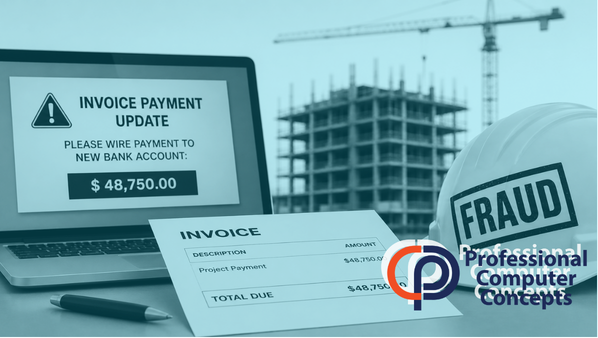
Construction companies in the Bay Area are not just dealing with tight timelines and rising costs, they’re increasingly dealing with construction invoice fraud in the Bay Area, and many don’t see it coming.
Most don’t think of themselves as cybersecurity targets.
That’s a mistake.
Right now, across the Bay Area, construction firms are being quietly targeted—not with ransomware or flashy attacks, but with something far simpler and far more effective: invoice and permit-related fraud.
And in many cases, the money is gone before anyone realizes what happened.
This Doesn’t Start With Hacking – It Starts With Public Information
If your company pulls permits, manages projects, or works with subcontractors, your information is already out there.
Project names. Addresses. Timelines. Sometimes even vendor relationships.
That’s all an attacker needs.
They don’t break in. They observe.
Then they act.
If you’ve seen recent alerts about local scams, you’re not imagining it: Novato businesses are already being targeted.
How Construction Invoice Fraud Actually Happens
It usually looks like this:
A construction company is actively working on a project. Vendors, subcontractors, and payments are moving as expected.
Then an email comes in.
It looks legitimate. It references the correct project. The timing makes sense.
The request is simple:
- Updated payment instructions
- A revised invoice
- A change in banking details
Nothing feels out of place.
So the payment gets processed.
Only later—sometimes days or weeks later—does the real vendor follow up asking why they haven’t been paid.
By then, the money is gone.
This is a classic form of business email compromise in construction, and it’s becoming more common.
Why Construction Companies Are Easy Targets
This isn’t random.
Construction companies are being targeted because of how the business operates:
Multiple vendors and subcontractors
Frequent payment changes
Fast-moving projects
Field teams working remotely
Heavy reliance on email communication
It creates the perfect environment for fraud to blend in.
No alarms. No obvious red flags.
Just a normal-looking request at the wrong moment.
Where Permit Fraud Fits In
You may have already seen warnings about permit-related phishing scams—especially locally.
That’s not a separate issue.
It’s part of the same playbook.
Attackers use permit data to:
- Identify active projects
- Learn company names and roles
- Time their outreach
👉 That’s how the email looks so convincing
For a deeper look at how these scams are evolving, see our breakdown of permit fraud cybersecurity risks.
This is not a coincidence. It’s targeted.
The Real Problem: You Won’t Catch This in Time
Most businesses assume:
“We’d notice if something was off.”
In reality:
- The email looks correct
- The request is expected
- The process already exists
There’s nothing obviously “wrong” until it’s too late.
This is not a technology failure.
It’s a process + verification failure.
What Actually Prevents Construction Fraud (It’s Not Just Software)
More tools won’t fix this on their own.
What works is a combination of:
Verification Controls
Any change to payment details should require:
- A second layer of approval
- A known, trusted verification method (not email)
Stronger Email Security
Basic filtering isn’t enough anymore.
You need:
- Detection for impersonation attempts
- Domain and sender validation
- Monitoring for suspicious patterns
If you’re unsure what that should look like, this is where a managed cybersecurity approach becomes critical.
Staff Awareness (Without Overcomplicating It)
Your team doesn’t need to become cybersecurity experts.
But they do need to recognize:
- Payment change requests
- Urgency language
- Slight inconsistencies
Clear Ownership
If “everyone” is responsible for verifying payments, no one is.
Assign ownership.
Define the process.
Stick to it.
Why This Matters More Than You Think
This isn’t theoretical.
Construction firms are losing:
- Tens of thousands
- Sometimes hundreds of thousands
- In a single transaction
And unlike ransomware, there’s often:
- No recovery
- No system to restore
- No easy rollback
Just a financial loss and a difficult conversation.
Where Most Businesses Go Wrong
They assume:
- “We’re too small to be targeted”
- “Our accounting team would catch it”
- “Our email security would block it”
None of those assumptions hold up anymore.
These attacks work specifically because they don’t look like attacks.
From PCC’s Desk
This is where the conversation is shifting.
It’s no longer just about protecting systems; it’s about protecting how your business operates day to day.
If your company is processing invoices, managing vendors, or running active projects, this applies to you.
And if your IT strategy is still reactive, you’re already behind.
A proactive approach—where systems, processes, and security are aligned—is what actually reduces risk over time. That’s the difference between putting out fires and preventing them in the first place.
The question isn’t whether these scams exist.
It’s whether your process would catch one.
If you’re not sure, that’s worth a conversation.
Not Sure If Your Process Would Catch This?
Most construction companies don’t realize they have a gap until money is already gone.
If you’re not 100% confident your team would catch a fraudulent payment request, it’s worth taking a closer look.
At Professional Computer Concepts, we work with construction companies across the Bay Area to identify where process and verification breakdowns can lead to real financial loss—and how to fix them without slowing your business down.
Let’s walk through your current process and identify any gaps before they become expensive.
👉 Schedule a quick conversation
Want to Read More?
- Novato Businesses Are Being Targeted by Permit Fraud Scams
- Permit Fraud Cybersecurity: Phishing Scams Targeting Novato Businesses
- Santa Rosa Businesses Targeted by Vendor Payment Scams
- Phishing vs. Spear Phishing vs. BEC: Know the Difference
- Don’t Fall for It: How to Spot and Stop BEC Invoice and Urgent Payment Scams
- The Small Business Guide to Cybersecurity