
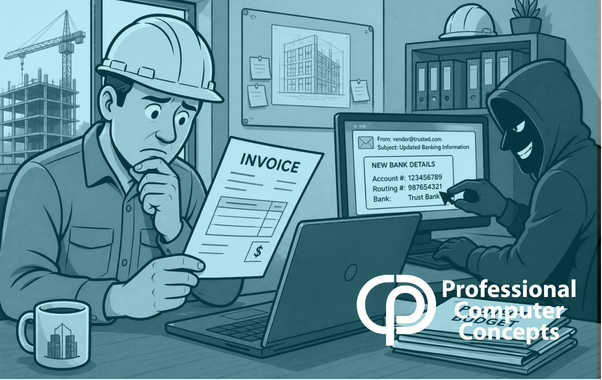
Construction invoice fraud small business risk is rising—especially for construction companies that rely on fast-moving payments and informal processes.
Most small construction companies don’t think they’re targets for this kind of fraud.
That assumption is exactly what makes them easy targets.
Construction invoice fraud isn’t random. It’s calculated. And construction companies are one of the most predictable—and profitable—groups to go after.
Why Construction Invoice Fraud Targets Small Businesses
Construction runs on urgency, moving parts, and constant communication between vendors, subcontractors, and project managers.
That creates three conditions attackers look for:
First, money is always moving.
Invoices, deposits, progress payments—there’s a steady flow of transactions that don’t always get double-checked.
Second, communication is fragmented.
Emails, texts, calls, field updates. It’s easy for one message to slip through without verification.
Third, timing matters more than process.
When a project is moving, no one wants to be the person holding things up over “one more check.”
Attackers don’t need to break in with sophisticated tools. They just need to blend in long enough to redirect one payment.
How Construction Invoice Fraud Actually Happens
This usually starts with a compromised or spoofed email.
It might look like a subcontractor you’ve worked with for years. Or a vendor you just paid last month.
The message is simple:
“Hey, we’ve updated our banking information. Please send the next payment here.”
No urgency. No red flags. Just enough familiarity to feel routine.
In some cases, attackers monitor conversations before they act. They wait until an invoice is expected, then step in at the exact right moment.
This is known as Business Email Compromise, and it’s one of the most effective financial scams targeting businesses today.
If you want to see how this plays out step by step, this breakdown explains how business email compromise leads to construction invoice fraud.
Why Small Companies Are More Exposed
Larger companies often have layers of approval, finance teams, and stricter controls.
Small construction companies usually don’t.
Instead, you have:
- One person handling invoices
- A project manager approving payments
- An owner stepping in when needed
It works—until it doesn’t.
There’s rarely a formal verification process for payment changes. And even when there is, it’s not always followed under pressure.
The real issue isn’t technology. It’s process.
This is why process failure creates real cybersecurity risk in construction companies.
The Moment It Goes Wrong
There’s no alert. No system warning you.
The payment goes through like any other.
And then:
- The vendor says they never received it
- The bank can’t reverse it
- The money is gone
At that point, it’s not an IT problem. It’s a financial loss.
If you’re in the Bay Area, this isn’t theoretical. Local businesses are already dealing with it:
→ Why Bay Area Construction Companies Are Losing Money to Invoice & Permit Fraud
“We’d Catch That” — The Assumption That Fails
Most business owners believe they would notice something off.
But invoice fraud doesn’t rely on obvious mistakes. It relies on routine.
The email looks right.
The timing makes sense.
The request feels normal.
That’s why it works.
What Actually Reduces Risk
This isn’t about telling your team to “be more careful.”
That doesn’t scale, and it doesn’t hold under pressure.
What works is structure:
- Verifying any change in payment details through a second channel
- Standardizing how invoices are approved and paid
- Locking down who can make financial changes
- Monitoring for suspicious activity before it becomes a problem
Most companies don’t implement this until after something happens.
If you’re already thinking about it now, you’re ahead of where most businesses start.
For a deeper look at what companies still get wrong when trying to fix this:
→ Preventing Construction Invoice Fraud: What Most Companies Still Get Wrong
Final Thoughts
Invoice fraud doesn’t require a sophisticated breach. It requires a predictable environment.
That’s what most construction companies have.
At Professional Computer Concepts, we work with businesses that assume they’re “too small” to be targeted—until they see how these attacks actually happen.
If your current setup relies on trust, speed, and informal processes, it’s worth taking a closer look before something forces the issue.
👉 Schedule a quick conversation
Want to Read More?
- Novato Businesses Are Being Targeted by Permit Fraud Scams
- Permit Fraud Cybersecurity: Phishing Scams Targeting Novato Businesses
- Santa Rosa Businesses Targeted by Vendor Payment Scams
- Phishing vs. Spear Phishing vs. BEC: Know the Difference
- Don’t Fall for It: How to Spot and Stop BEC Invoice and Urgent Payment Scams
- The Small Business Guide to Cybersecurity