
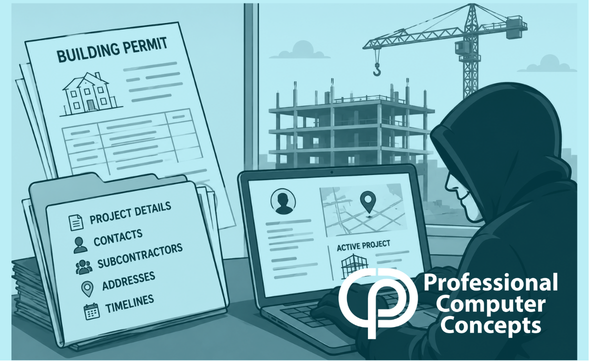
TL;DR | Many construction companies do not realize how much operational information is publicly available online. Cybercriminals increasingly use permits, vendor details, websites, and project information to create convincing phishing scams, invoice fraud attempts, and impersonation attacks.
Most construction companies assume cyberattacks happen randomly.
In reality, many attacks start with research.
Cybercriminals increasingly gather publicly available information before targeting businesses. The more operational detail they can collect, the more believable their scams become.
Construction companies are particularly exposed because large amounts of project and contact information are often publicly accessible through:
- permit applications
- company websites
- vendor directories
- subcontractor listings
- chamber memberships
- project announcements
Individually, none of this information seems dangerous.
Together, it creates a roadmap.
Construction Businesses Share More Information Than They Realize
Modern construction operations depend heavily on communication and visibility.
Project managers, estimators, vendors, subcontractors, inspectors, and accounting teams all need to coordinate constantly.
As a result, operational details are often publicly visible online without anyone thinking twice about it.
A permit record may reveal:
- project names
- contractor information
- addresses
- timelines
- business contacts
Company websites often reveal:
- employee names
- email formats
- vendor relationships
- office locations
- organizational structure
LinkedIn profiles can reveal:
- job responsibilities
- reporting structures
- software platforms
- current projects
None of this automatically creates a security problem.
But attackers use this information to build trust-based attacks that feel legitimate.
Construction Permit Fraud Often Starts with Familiar Information
Many phishing and invoice fraud attacks succeed because the message appears operationally normal.
An attacker may reference:
- a real project
- an actual subcontractor
- a permit address
- a known employee
- a legitimate vendor relationship
The email may not look suspicious at all.
In some cases, cybercriminals spend time monitoring communication patterns before attempting fraud. The more information they gather, the easier it becomes to impersonate trusted contacts convincingly.
This is one reason construction permit fraud and business email compromise attacks have become increasingly effective.
The attackers are not guessing randomly.
They are using operational context against the business.
Fast-Moving Construction Environments Create Opportunity
Construction companies move quickly.
Employees are coordinating schedules, materials, inspections, payments, revisions, and field communication simultaneously.
That pace creates operational pressure.
When people are busy, they are less likely to stop and question:
- a payment change request
- a file-sharing link
- a password reset email
- a request for updated vendor information
Attackers understand this.
Many scams today are designed specifically to blend into normal business operations instead of standing out obviously.
That shift is important.
Cybersecurity is no longer just about blocking obvious threats.
It is increasingly about recognizing manipulation hidden inside legitimate-looking business communication.
Visibility Is Not the Problem — Awareness Is
This does not mean construction companies should stop marketing themselves or hide from public visibility.
The issue is awareness.
Many businesses simply do not realize how much information can be pieced together externally.
Understanding that reality changes how companies think about:
- payment verification
- employee awareness
- account security
- remote access
- vendor communication
- operational processes
The businesses adapting successfully are usually the ones recognizing that operational security and cybersecurity are now closely connected.
Final Thoughts
Most construction companies do not realize public information is being used against them until an incident happens.
The goal is not to operate in secrecy.
The goal is understanding how visible operational information changes the way modern cybercriminals target businesses.
Construction companies that recognize this early are often far better positioned to reduce fraud risk, improve internal processes, and avoid costly operational disruption later.
Professional Computer Concepts helps Bay Area businesses strengthen operational security, reduce technology-related risk, and build more reliable systems designed to support growth without unnecessary exposure.