
TL;DR An effective automation strategy for small business starts with clarity, not tools. Automating the wrong processes can increase confusion, complexity, and inefficiency instead of solving real problems.
Automation promises relief. Faster workflows. Fewer manual tasks. More time back in your day.
For many owners, developing an automation strategy for small business feels like the natural next step. When work piles up or systems begin to strain, technology seems like the obvious answer. Add a tool. Connect a workflow. Let the system handle it.
But there’s an uncomfortable reality many businesses discover too late. Automation does not fix confusion. It scales it.
True efficiency is not about doing more, faster. It is about understanding what is worth doing at all.
Why Automation Strategy for Small Business Often Falls Short
We live in a business culture obsessed with speed. Faster responses. Faster reporting. Faster execution.
Automation feeds that obsession. It creates motion quickly and visibly. Tasks fire off automatically. Reports arrive on schedule. Dashboards light up with activity.
It looks productive. It feels controlled.
Yet speed without direction is not progress. It is acceleration without intention. When unclear processes are automated, inefficiency does not disappear. It multiplies.
The Paradox of Convenience
Convenience often masquerades as clarity.
A new platform for every pain point. Another workflow to connect them. One more dashboard to track what the last dashboard missed. Over time, the stack grows, and so does the noise.
Automation amplifies whatever exists beneath it. Clear workflows become smoother. Confused workflows become faster chaos.
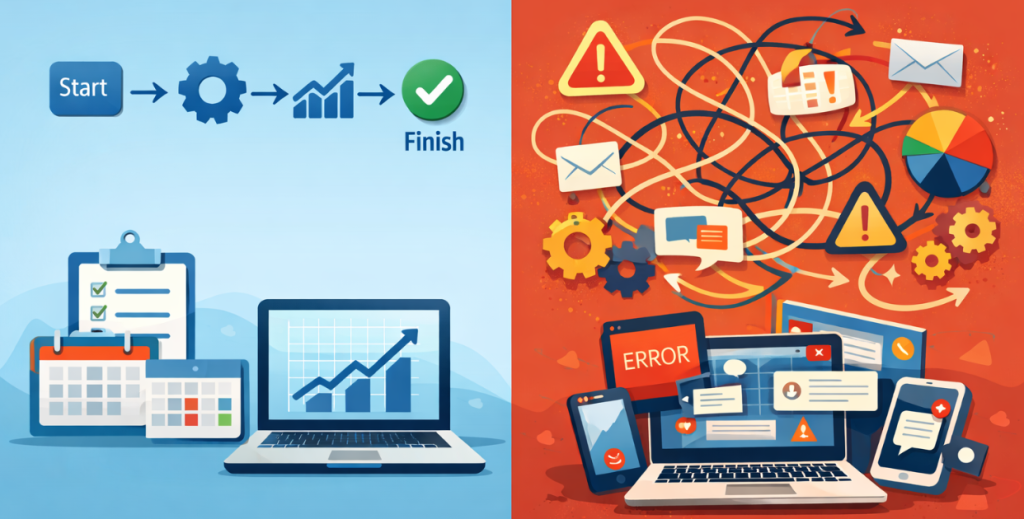 A broken process does not improve when it is digitized. It simply runs faster in the wrong direction. This is where an automation strategy for small business begins to break down.
The Paradox of Convenience
Convenience often masquerades as clarity.
A new platform for every pain point. Another workflow to connect them. One more dashboard to track what the last dashboard missed. Over time, the stack grows, and so does the noise.
Automation amplifies whatever exists beneath it. Clear workflows become smoother. Confused workflows become faster chaos.
A broken process does not improve when it is digitized. It simply runs faster in the wrong direction. This is where an automation strategy for small business begins to break down.
The False Comfort of Busyness
There is a deep satisfaction in watching systems work on your behalf. Invoices send automatically. Emails trigger themselves. Reports appear like clockwork.
It feels efficient. But sometimes it is just motion without meaning.
Many small business leaders end up spending more time monitoring systems than engaging with clients or thinking strategically. Busyness becomes a substitute for effectiveness.
Technology can track everything, but it cannot tell you why something matters. Without intention, automation is decoration, not discipline.
When Technology Becomes the New Paperwork
In the past, inefficiency showed up as stacks of paper. Today it appears as tabs, logins, alerts, and overlapping tools.
Each platform adds another process to manage, another place where information can drift out of sync. What was meant to simplify quietly becomes administrative overhead.
Instead of reducing effort, technology often redistributes it invisibly across your day.
Automation does not create order. It reveals whether order existed in the first place.
The Strategy Gap Most Businesses Skip
This is where many organizations go wrong. They automate before they understand.
They skip mapping workflows. They skip defining outcomes. They skip asking why a process exists at all. The market rewards urgency, not reflection, and technology vendors are happy to move fast.
But a strong automation strategy for small business requires clarity before execution.
The most effective businesses pause first. They ask a deceptively simple question: What is actually worth automating?
Why This Matters Even More With AI
We are seeing this same pattern play out with AI adoption for business.
AI promises intelligence instead of automation, but the risk is identical. When AI is layered onto unclear processes, it does not create insight. It accelerates confusion with confidence.
This is why many organizations feel underwhelmed by AI results. Not because AI lacks capability, but because intelligence cannot compensate for ambiguity.
AI, like automation, is execution. And execution without reflection is costly.
What True Efficiency Looks Like
True efficiency does not begin with tools. It begins with understanding.
When processes align with purpose, automation enhances them. When people understand why work is done, they can decide whether it should be done at all.
Efficiency is not about doing everything faster. It is about doing the right things well.
In a well-designed system, technology becomes quieter, not louder. Not because it disappears, but because it works in harmony with how the business thinks.
Visibility Comes Before Efficiency
You cannot improve what you cannot see.
Before you automate, map. Before you digitize, measure. Before you connect systems, clarify outcomes.
Sometimes the most transformative step is not another integration. It is a conversation that defines a clear automation strategy for small business before tools are introduced.
That is where real IT partnership lives. Not in the tools themselves, but in the thinking behind them.
Did You Know? Many small businesses implementing an automation strategy for small business see limited results because they automate inefficient processes instead of fixing them first. [Source: Industry Analysis]
About Professional Computer Concepts
Professional Computer Concepts (PCC) is a trusted Managed IT and Cybersecurity provider serving the Bay Area for over 20 years. We help small and midsize businesses simplify their IT, strengthen security, and modernize operations. Explore our services:
Managed IT Services | Cybersecurity | Cloud Solutions
Final Thought
The illusion of efficiency is comforting because it feels like control. But control does not come from technology. It comes from understanding.
A successful automation strategy for small business does not begin with tools. It begins with clarity.
Before you automate the next process or deploy the next AI tool, pause. Ask whether you are solving the right problem.
Sometimes slowing down is the only way to move forward.
Editor’s note: This article was originally shared with our LinkedIn newsletter audience and has been adapted here as part of our ongoing work to help business leaders think more clearly about technology, automation, and AI.