
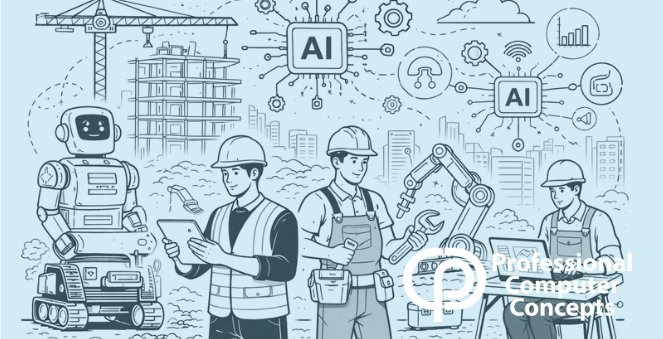
TL;DR AI in construction jobs is not replacing workers—it is increasing demand for skilled trades by making job sites more complex, connected, and technology-driven.
The conversation around AI in construction jobs often starts with concern. Automation is advancing, and it is natural to assume that fewer workers will be needed over time.
That assumption does not hold up in the field.
Construction is one of the clearest examples of how technology changes work without eliminating it. As AI becomes more integrated into planning, forecasting, and project management, the need for skilled professionals on-site is increasing—not decreasing.
AI Is Changing the Job Site, Not Replacing It
AI is already influencing construction in meaningful ways.
It is being used to:
- Analyze project timelines
- Predict delays and cost overruns
- Improve safety monitoring
- Optimize resource allocation
These capabilities improve efficiency, but they operate at a planning and data level.
Execution still happens in the real world.
Buildings are constructed, systems are installed, and problems are solved on-site. These tasks require adaptability, experience, and decision-making in environments that are constantly changing.
AI supports the process. It does not replace it.
The Growing Demand for Skilled Trades
As technology becomes more embedded in construction workflows, the role of skilled trades is evolving.
Workers are not just performing physical tasks. They are interacting with digital plans, mobile systems, and connected tools.
This creates a higher bar for expertise.
Electricians, project managers, and field technicians now need to understand both the physical and digital sides of their work. That combination is harder to find, and demand is increasing as a result.
At the same time, fewer workers have entered the trades in recent years. The supply gap is becoming more noticeable as projects become more complex.
Where IT and Infrastructure Come In
One of the most overlooked aspects of AI in construction jobs is the role of IT.
Modern job sites depend on:
- Reliable internet connectivity
- Secure access to cloud platforms
- Device management across field teams
- Data protection for project files and communications
When any of these fail, work slows or stops.
Construction companies are no longer just managing projects. They are managing technology environments that need to function consistently across offices, job sites, and remote teams.
This is where having the right IT support becomes critical.
If your team is relying on connected systems to keep projects moving, it’s worth understanding how specialized IT support can help.
👉 Engineering & Construction IT Support
Did You Know? According to McKinsey, the construction industry has historically lagged in productivity growth, but digital tools and AI are expected to significantly improve efficiency in the coming years.
The Risk of Misunderstanding AI
There is a risk in how businesses interpret AI.
If leadership assumes technology will reduce the need for skilled labor, they may underinvest in hiring, training, and retention. That creates operational challenges later.
The reality is the opposite.
AI increases the need for people who can execute, adapt, and manage complexity in real environments. Businesses that recognize this early are better positioned to scale.
Related Reading
Read more in The Small Business Guide to Cybersecurity
Learn how Managed IT Support Services can help you stay secure
Explore Building Cyber Resilience in an Unstable World
About Professional Computer Concepts
Professional Computer Concepts (PCC) is a trusted Managed IT and Cybersecurity provider serving the Bay Area for over 20 years. We help small and midsize businesses simplify their IT, strengthen security, and modernize operations. Explore our services:
Managed IT Services | Cybersecurity | Cloud Solutions
From PCC’s Desk
Technology is changing construction, but it is not replacing the people who make projects possible.
If anything, it is making their role more critical.
The companies that succeed will be the ones that support both sides of the equation. Strong field teams and reliable technology working together.
If you are looking at how to better support your team as your systems evolve, let’s talk.