
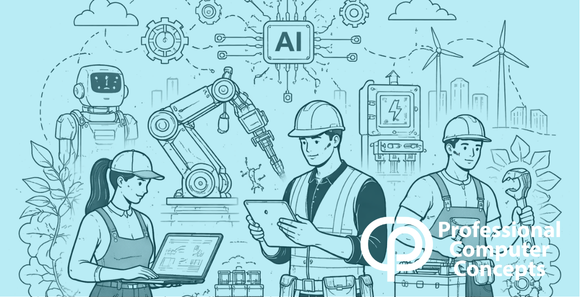
TL;DR AI and jobs are not a zero-sum equation. While automation is reshaping certain roles, it is also increasing demand for skilled trades and hands-on work that technology cannot replace.
The conversation around AI and jobs is often framed as a threat. The assumption is simple: as artificial intelligence improves, human jobs disappear.
That narrative is incomplete.
A recent article in Marin Magazine, “Dirty Jobs Host Mike Rowe on the Rise of Trade Jobs and AI’s Surprising Role,” highlights something many businesses are starting to notice firsthand. The piece pushes back on the idea that AI is eliminating work, pointing instead to a growing demand for skilled trades. It emphasizes that as technology advances, roles that require hands-on expertise, problem-solving, and physical execution are becoming more valuable, not less.
As AI takes on more digital and administrative tasks, the need for people who can build, fix, and operate in the real world is increasing. Instead of replacing work, AI is reshaping where human value is most needed.
This shift has real implications for how businesses, especially those in hands-on industries like construction, think about hiring, operations, and long-term strategy.
The Assumption: AI Replaces Jobs
The fear around AI and jobs comes from a familiar pattern. Automation has historically reduced the need for repetitive labor. Manufacturing, data entry, and basic administrative roles have all been affected.
It is reasonable to assume that AI will continue that trend.
But that assumption relies on a narrow view of work. It focuses on tasks that are easy to standardize, predict, and automate. It ignores the large portion of the workforce that operates in environments where variability, judgment, and physical execution matter.
That is where the narrative begins to shift.
The Reality: AI Is Changing Where Work Happens
AI excels at processing information, identifying patterns, and accelerating digital workflows. What it cannot do effectively is operate in the physical world with the same adaptability as a human.
That distinction matters.
As AI handles more digital and administrative tasks, businesses are reallocating resources. The result is increased demand for roles that require hands-on expertise, problem-solving in real environments, and direct interaction with physical systems.
This includes electricians, HVAC technicians, construction professionals, and other skilled trades.
The article featuring Mike Rowe points out this exact trend. As technology advances, the gap between digital automation and physical execution becomes more visible. And that gap needs to be filled by people.
Why Skilled Trades Are Gaining Value
There are a few underlying forces driving this shift.
First, infrastructure still needs to be built, maintained, and repaired. AI can help design systems or predict failures, but it cannot physically install wiring, fix plumbing, or manage a construction site.
Second, modern systems are becoming more complex. Smart buildings, connected devices, and advanced machinery require technicians who understand both the physical and digital layers.
Third, fewer people have entered the trades over the past decade. At the same time, demand has remained steady or increased. That imbalance is now becoming more apparent.
AI is not creating the need for these roles. It is exposing how essential they already are.
What This Means for Businesses
This shift in AI and jobs is not theoretical. It is already affecting how businesses operate.
Companies that rely on physical infrastructure, field work, or specialized equipment are feeling the pressure. Hiring skilled workers is becoming more difficult. Retention is becoming more important.
At the same time, businesses are adopting AI tools to streamline operations, improve efficiency, and reduce administrative overhead.
The combination creates a new dynamic:
- Less time spent on routine tasks
- More reliance on skilled, hands-on expertise
- Higher expectations for operational efficiency
Organizations that recognize this early can adjust their strategy. That might mean investing in training, reevaluating hiring priorities, or improving how technology supports their workforce.
Why This Matters for Construction and AEC Firms
This shift is especially visible in construction and Architecture, Engineering, and Construction (AEC) environments.
Job sites are becoming more connected. Cloud-based plans, mobile devices, project management platforms, and real-time collaboration tools are now standard. AI is starting to influence scheduling, forecasting, and risk analysis.
But none of that replaces the need for skilled professionals on-site.
If anything, it increases the pressure on them.
Field teams are now expected to interact with more technology while still executing physical work. When systems fail, access is lost, or connectivity breaks down, productivity stops immediately. There is no buffer.
At the same time, the gap between digital systems and physical execution is widening. Someone still has to bridge that gap.
We’re seeing this firsthand across construction firms in the Bay Area. As projects become more technology-driven, the need for reliable IT infrastructure and support becomes critical to keeping work moving.
If you’re navigating that shift, you can learn more about how we support these environments through our construction-focused IT services: Construction IT Support and Services
The Overlooked Opportunity
Most discussions about AI and jobs focus on risk. Job loss, displacement, and uncertainty dominate the conversation.
There is another angle that deserves attention.
AI is creating space for people to focus on work that requires judgment, adaptability, and real-world execution. In many cases, that work is more valuable and harder to replace.
This is particularly relevant for industries like construction, manufacturing, and field services. These sectors are not being eliminated by AI. They are being elevated.
Businesses that lean into this shift can gain an advantage.
Did You Know? According to the World Economic Forum’s Future of Jobs Report, while automation is expected to displace some roles, it is also projected to create millions of new jobs, particularly in skilled and technical fields.
How Technology Should Support the Workforce
There is a mistake some companies make when thinking about AI adoption. They treat it as a replacement strategy instead of a support strategy.
That approach creates friction.
A more effective model is to use AI to remove inefficiencies while strengthening the human side of operations. That includes:
- Reducing manual administrative work
- Improving visibility into operations
- Enhancing communication and coordination
- Supporting decision-making with better data
When done correctly, technology amplifies the workforce instead of competing with it.
This is where IT strategy becomes critical.
Related Reading
Read more in The Small Business Guide to Cybersecurity
Learn how Managed IT Support Services can help you stay secure
Explore Building Cyber Resilience in an Unstable World
About Professional Computer Concepts
Professional Computer Concepts (PCC) is a trusted Managed IT and Cybersecurity provider serving the Bay Area for over 20 years. We help small and midsize businesses simplify their IT, strengthen security, and modernize operations. Explore our services:
Managed IT Services | Cybersecurity | Cloud Solutions
From PCC’s Desk
There is a tendency to view new technology through a lens of fear. That reaction is understandable, but it is not always accurate.
AI is changing how work gets done. It is also highlighting where people matter most.
The businesses that will do well are not the ones trying to replace their workforce. They are the ones figuring out how to support it more effectively.
If you are thinking about how AI fits into your business, or how your IT strategy should evolve alongside it, let’s talk.