
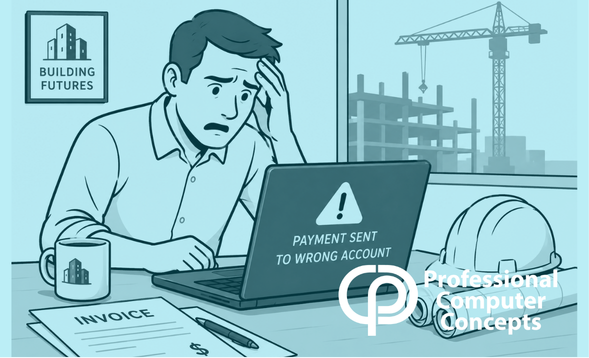
TL;DR | Construction invoice fraud is not just a cybersecurity problem. One successful payment scam can disrupt projects, damage vendor relationships, create accounting chaos, and expose operational weaknesses that cost far more than the stolen funds themselves.
A payment gets approved.
The invoice looks legitimate. The email thread appears normal. The vendor name is correct.
Money gets sent.
Then someone realizes the banking information was changed.
Now the construction company is trying to determine:
- where the process failed
- whether the bank can recover the funds
- if the subcontractor still needs to be paid
- how many other accounts may be compromised
For many businesses, this is the moment cybersecurity suddenly becomes real.
Construction invoice fraud is no longer rare, and the financial loss is often only the beginning.
Construction Companies Are Prime Targets for Payment Fraud
Construction companies move money constantly.
Vendors, subcontractors, materials, permits, consultants, equipment providers, and project-related expenses create an environment where invoices and payment requests are part of daily operations.
Cybercriminals understand this.
They also understand that construction environments tend to move quickly. Teams are busy. Deadlines matter. Employees are coordinating across jobsites, offices, and mobile devices.
That combination creates opportunity.
Many attacks now involve business email compromise (BEC), where attackers gain access to an email account or convincingly impersonate one. Once inside the communication flow, they monitor conversations and wait for the right moment to alter payment instructions.
The request often looks completely normal.
That is why these attacks are so effective.
The Operational Damage Often Exceeds the Financial Loss
When people think about fraud, they usually focus on the dollar amount stolen.
But the operational fallout is often worse.
Accounting teams suddenly stop normal work to investigate transactions.
Leadership gets pulled into emergency conversations.
Projects may slow down while vendors and payments are sorted out.
Employees begin questioning processes internally.
In some situations, subcontractors still expect payment because they never received the original funds.
Now the company may be dealing with:
- duplicate payments
- strained vendor relationships
- legal or insurance complications
- delayed project timelines
- internal distrust
- reputational damage
Even if some money is recovered, the disruption rarely disappears overnight.
Construction Invoice Fraud Usually Exposes Existing Process Weaknesses
Most successful fraud attacks do not happen because a company is careless.
They happen because normal operational habits create small gaps over time.
Verification procedures become inconsistent.
Employees rely too heavily on email.
Payment changes are approved informally.
Shared accounts and weak passwords remain in use.
Temporary processes become permanent processes.
This is why construction invoice fraud is often tied directly to operational maturity, not just cybersecurity tools.
Companies that standardize procedures and verification workflows tend to reduce risk significantly.
Cybersecurity Is Now Part of Business Operations
Many construction firms still think of cybersecurity as a technical issue handled by “the IT people.”
That mindset is becoming increasingly dangerous.
Today, operational security affects:
- financial stability
- project continuity
- vendor trust
- insurance requirements
- client confidence
Construction companies are increasingly expected to protect sensitive communications and financial processes the same way they protect physical jobsite operations.
The businesses adapting to this shift now are usually the ones avoiding larger problems later.
Prevention Usually Looks Boring — Until It Matters
Most effective fraud prevention measures are not flashy.
They involve:
- verification procedures
- standardized payment approval processes
- secure access controls
- employee awareness
- multi-factor authentication
- consistent device management
- monitoring unusual account activity
None of those things feel urgent when operations appear to be running normally.
But after one successful fraud incident, they suddenly become priorities.
Unfortunately, by then, the business is already dealing with the consequences.
Final Thoughts
Construction invoice fraud is rarely just about stolen money.
One successful incident can create operational disruption that affects projects, vendors, employees, and leadership long after the payment itself is gone.
The companies reducing risk successfully are usually not the ones reacting fastest after an incident.
They are the ones building stronger operational and security processes before something goes wrong.
Professional Computer Concepts helps Bay Area businesses improve operational security, reduce technology-related risk, and create more reliable systems that support long-term growth instead of constant reaction.
About Professional Computer Concepts
Professional Computer Concepts is a Bay Area Managed IT and Cybersecurity provider that helps businesses stay productive, secure, and prepared for growth. We work closely with businesses to reduce downtime, improve security, and simplify technology so teams can focus on running their business instead of dealing with IT problems. Learn more about our Managed IT Services, Cybersecurity Services, Cloud Solutions, and IT Consulting Services.