
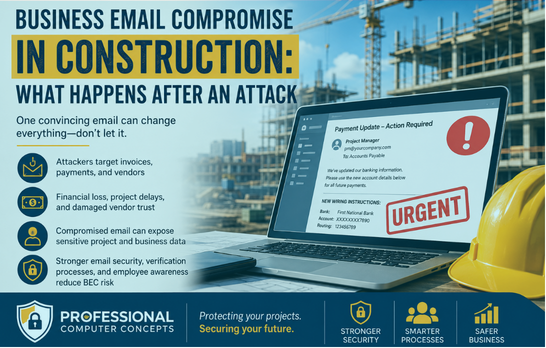
TL;DR Business email compromise construction attacks are dangerous because they target the way construction companies already work: invoices, vendor payments, subcontractors, deposits, and project communication. The damage often goes beyond one fraudulent payment. A single compromised email account can create financial loss, project delays, vendor confusion, insurance complications, and a loss of trust in the company’s communication systems.
Business email compromise in construction does not usually look like a dramatic cyberattack. There may be no locked screen, no ransom note, and no obvious malware alert. In many cases, the attack starts with a believable email that appears to come from someone the company already knows.
That is what makes business email compromise, often called BEC, so effective. It blends into normal business operations. For construction companies, where invoices, change orders, vendor payments, and project updates move quickly, that creates real risk.
Construction businesses are especially vulnerable because they often rely on a mix of office staff, field teams, owners, vendors, subcontractors, and project managers. When communication moves fast, a well-timed fraudulent email can slip through before anyone realizes something is wrong.
What Is Business Email Compromise?
Business email compromise is a type of cyber fraud where an attacker uses email to trick a business into sending money, changing payment instructions, sharing sensitive information, or taking an action that benefits the criminal.
Sometimes the attacker breaks into a real mailbox. Other times, they spoof an email address or create a lookalike domain that is hard to notice at a glance. The goal is usually the same: make the message look familiar enough that the recipient acts without slowing down.

Business email compromise construction attacks often target invoices, vendor payments, and project communication.
In construction, BEC often shows up as a fake invoice, a request to change bank account information, a message that appears to come from an owner or executive, or a vendor payment request that looks legitimate.
This is not just an email problem. It is an identity problem. If an attacker can impersonate a trusted person, vendor, or company, they may be able to bypass normal caution.
BEC is more than an email-security problem. It is a social engineering attack designed to manipulate employees into changing payments, sharing information, or bypassing normal procedures.
Why Are Construction Companies Targeted?
Construction companies are attractive targets because money moves through many hands. A single project may involve general contractors, subcontractors, suppliers, architects, engineers, lenders, property owners, and municipal contacts.
That creates a large communication surface. Attackers do not need to understand every part of the business. They only need to understand enough to send a convincing message at the right time.
Public information can also help criminals. Permits, project addresses, company names, and vendor relationships may be visible online. Attackers can use that information to make fraudulent emails feel specific and credible.
A generic phishing email is easy to ignore. An email that references an active project, a known vendor, or a pending invoice is much harder to dismiss.
Did You Know? According to the FBI’s 2025 Internet Crime Report, losses reported to IC3 surpassed $20 billion in 2025, with business email compromise listed among the major loss categories. Verizon’s 2025 Data Breach Investigations Report also noted that more than $6.3 billion was transferred as part of BEC scams in 2024.
What Happens After a Construction Company Gets Hit?
The first impact is usually financial. For construction companies, that financial loss can quickly affect active jobs. A diverted payment may delay materials, create tension with subcontractors, interrupt project timelines, or force the company to pay twice while the issue is investigated. Even when the fraud starts in email, the damage shows up in operations.
But the financial loss is only part of the problem.
The company may need to contact its bank, file a report with the FBI’s Internet Crime Complaint Center, notify its cyber insurance carrier, and begin reviewing who had access to what. If a real mailbox was compromised, the company must determine how long the attacker had access and what they may have seen.
That part matters. A compromised mailbox may contain invoices, project details, employee information, client communication, contracts, insurance documents, and vendor records. Even if no money was stolen, the exposure can still create risk.
The business may also need to contact vendors or clients to warn them about fraudulent messages. That can be uncomfortable, especially when trust is central to the relationship.
Internally, these incidents often create tension. People start asking who clicked what, who approved the payment, and why no one caught it sooner. That reaction is understandable, but blame does not fix the security gap. The better question is: what allowed the attacker to look trustworthy in the first place?
How BEC Damages Client and Vendor Trust
BEC can create an uncomfortable trust problem. Vendors may wonder whether future payment instructions are safe. Clients may worry about project communication. Employees may become nervous about approving routine requests.
That is why recovery should include more than technical cleanup. Construction companies may need to explain what changed, confirm safe communication channels, and reassure vendors and clients that payment workflows have been tightened.
The Part Many Businesses Miss: The Attacker May Have Been Watching
One of the most overlooked risks in a BEC incident is that the attacker may have spent time reading email before making a move.
If a mailbox is compromised, the attacker may quietly study how the company communicates. They may learn who approves payments, which vendors are active, what projects are underway, and how people phrase normal requests.
That means the fraudulent message may not feel random. It may sound like the business. It may reference real work. It may arrive at a time when a payment or change order would not seem unusual.
This is why business email compromise is so damaging. The attacker is not only trying to fool a spam filter. They are trying to fool a person by using context.
How Can Construction Companies Reduce BEC Risk?

Construction companies can reduce business email compromise risk by combining employee awareness, MFA, and payment verification procedures.
Reducing BEC risk starts with making identity harder to abuse.
Multi-factor authentication should be required for email and cloud accounts. MFA is not perfect, but it makes account takeover harder. Companies should also review mailbox forwarding rules, because attackers often create hidden rules to copy, redirect, or hide messages.
Payment changes should never be approved by email alone. If a vendor requests new banking information, the company should verify the change using a known phone number already on file, not the number listed in the email.
Construction companies should also train employees to slow down around financial requests. A short pause before approving a payment can prevent a major loss. Office managers, controllers, project coordinators, and executives should all understand that BEC often targets normal business workflows, not just “technical” users.
From an IT perspective, sign-in monitoring, conditional access, endpoint protection, email security, and regular account reviews all help reduce risk. Businesses should also have an incident response plan before something happens, not after money is already gone.
Read more in The Small Business Guide to Cybersecurity. You may also find How Hackers Get In: The Most Common Ways Cybercriminals Attack Small Businesses and How to Easily Spot Phishing Attempts helpful.
Why Cyber Insurance May Not Be Simple After BEC
Construction companies should not assume cyber insurance will automatically cover every BEC loss. Carriers may ask whether MFA was enabled, whether payment verification procedures existed, how quickly the incident was reported, and whether the company followed its own internal controls.
That documentation matters. After a BEC incident, the company needs a clear record of what happened, who was involved, when the fraud was detected, what systems were reviewed, and what steps were taken to prevent it from happening again.
Business Email Compromise Is an Operations Problem, Not Just an IT Problem
It is tempting to treat BEC as something the IT provider should simply block. That is only partly true.
Technology matters. Email filtering, MFA, monitoring, and identity security all help. But business email compromise also exploits process. If a company has no clear rule for verifying bank changes, attackers will take advantage of that gap.
For construction companies, the right approach combines security controls with payment discipline. The goal is not to make work harder. The goal is to make high-risk actions harder to fake.
A good process protects employees too. When verification steps are required by company policy, staff are not put in the position of deciding whether to challenge a payment request on their own.
This is also why local invoice scams deserve attention. A construction BEC incident, a fake city invoice scam, and a permit-related phishing scam may look different on the surface, but they all exploit the same weakness: trusted payment workflows. Read our related articles on the Alameda fake city invoice scam and the Novato permit phishing scam to see how payment impersonation is showing up across Bay Area businesses.
How Professional Computer Concepts Helps Reduce BEC Risk
Professional Computer Concepts helps businesses reduce business email compromise risk by strengthening email security, identity protection, endpoint security, monitoring, and user awareness.
For construction companies, this often includes reviewing Microsoft 365 security settings, enforcing MFA, monitoring suspicious sign-ins, checking mailbox rules, improving employee training, and helping create practical payment verification processes.
The goal is not to bury teams in technical controls. The goal is to help businesses operate with fewer weak spots and better visibility when something looks wrong.
Explore our Cybersecurity services or learn more about Managed IT Services to see how proactive support can reduce risk before an incident disrupts your business.
About Professional Computer Concepts
Professional Computer Concepts (PCC) is a trusted Managed IT and Cybersecurity provider serving the Bay Area for over 20 years. We help small and midsize businesses simplify their IT, strengthen security, and modernize operations. Explore our services:
Managed IT Services | Cybersecurity | Cloud Solutions
Frequently Asked Questions about Business Email Compromise in Construction
What is business email compromise in construction?
Business email compromise in construction is a type of email-based fraud where attackers impersonate trusted people, vendors, subcontractors, or executives to steal money or sensitive information. It often targets invoices, payment changes, and project communication.
How do construction companies usually discover BEC?
Many companies discover BEC when a vendor says they were not paid, a bank flags a suspicious transfer, an employee notices an unusual email rule, or someone receives a message that does not sound quite right. Unfortunately, discovery often happens after money has already been sent.
Can MFA stop business email compromise?
MFA can reduce the risk of mailbox takeover, but it does not stop every BEC attempt. Attackers may still use spoofed email addresses, lookalike domains, or social engineering. MFA should be part of a broader security and verification strategy.
What should a company do first after a suspected BEC attack?
The company should contact its bank immediately, preserve evidence, report the incident to the FBI’s Internet Crime Complaint Center, notify its cyber insurance carrier if applicable, and have its IT provider review account access, mailbox rules, sign-ins, and related systems.
How can PCC help construction companies reduce BEC risk?
PCC helps construction companies strengthen email security, identity protection, monitoring, employee awareness, and incident response planning. We also help businesses create practical verification steps for payment and banking changes.
From PCC’s Desk
Business email compromise works because it takes advantage of normal business activity. Construction companies already have enough moving parts without wondering whether every invoice or payment request can be trusted.
The answer is not panic. The answer is preparation. Clear payment procedures, stronger identity controls, employee awareness, and proactive monitoring can make a meaningful difference.
If your business is ready to strengthen email security and reduce the risk of payment fraud, let’s talk.