

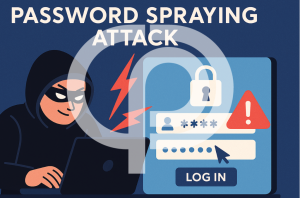
 Weak passwords are still one of the easiest ways for attackers to break into business systems. And one of the most overlooked threats? Password spraying attacks.
Unlike brute-force attacks that hammer away at a single account, password spraying goes wide. It quietly tests the same common password across many different accounts—slipping under the radar of most security tools. And if just one user reuses a weak or predictable password? That’s all it takes for an attacker to get in.
Let’s break down what password spraying is, how it works, how it differs from other types of attacks, and what you can do to protect your business.
How a Password Spraying Attack Works
A password spraying attack targets multiple accounts using a few carefully chosen passwords. Think: “Password123”, “Summer2024!”, or the company name followed by a number. These passwords come from public breach data or are based on patterns people commonly use.
Here’s how it usually plays out:
- An attacker gets a list of usernames (from public directories, data leaks, or OSINT tools).
- They test a single password across all usernames.
- If that doesn’t work, they try another password across the same accounts.
- Because they’re not rapidly guessing passwords on a single account, they avoid account lockouts and detection tools that look for brute-force patterns.
It’s a quiet, persistent, and effective way to compromise business accounts, especially in environments where password policies are weak or outdated.

How Is Password Spraying Different from Other Attacks?
It’s easy to confuse password spraying with other cyberattack methods, so here’s how it compares:
Traditional Brute-Force Attacks
A brute-force attack involves systematically trying many different passwords against a single account in rapid succession until the correct one is found or the account gets locked out. These attacks are loud, aggressive, and easier to detect because they target one account repeatedly. Learn how to use strong passwords to protect yourself.
Credential Stuffing
Credential stuffing uses stolen username-password combinations from past breaches to try logging into new accounts. It relies on the fact that many users reuse the same credentials across multiple platforms. These attacks are also widespread and automated but use known credentials instead of guessing.
Password Spraying
Password spraying flips the script. Instead of bombarding one account, it uses a small set of common passwords across many different accounts. It’s stealthy, slow, and highly effective, especially when password policies are weak or outdated.
Why This Attack Works So Well
It works because people reuse weak passwords.
Password spraying attacks rely on common behavior: using the same password everywhere, picking something easy to remember, and ignoring password updates. Even in companies with IT policies, weak enforcement can leave gaps.
Attackers know this and take advantage of:
- Poor password complexity
- A lack of MFA
- No system for monitoring login anomalies
- Gaps in employee training and awareness
One compromised account can give attackers access to sensitive data, lateral movement across systems, or a launchpad for phishing or ransomware. It’s also worth noting that password spraying can be used in combination with other attacks, like phishing, to escalate privileges or steal more data.
Want to make your team’s passwords stronger? Here’s how to do it right.
How to Detect and Prevent a Password Spraying Attack
The good news? These attacks are preventable if you know what to look for and set the right defenses in place.
1. Enforce Strong Password Policies
Stop users from using the most common or guessable passwords. Enforce complexity rules, minimum length requirements, and regular password changes. Encourage the use of password managers to reduce reuse and simplify compliance. Read: How Password Managers Protect Your Accounts and Password Managers: Do They Help or Hurt Your Security?

2. Turn On Multi-Factor Authentication (MFA) Everywhere
This is one of the most effective ways to stop attackers even if they have the correct password. MFA makes them work a lot harder and raises the chance you’ll catch them in the act.
3. Watch for Login Anomalies
Set up alerts for:
- Multiple failed logins across many accounts from the same IP address
- Login attempts from unusual locations or at unusual hours
- Patterns that match known attack behaviors (e.g., one password used across many accounts)
SIEM tools, cloud-native logs, and MDR services can help here.
4. Educate Your Team
Security isn’t just a tech problem—it’s a people problem. Make sure your team understands why strong passwords matter, how to spot phishing attempts, and what to do if they suspect something’s wrong.
Start by investing in security awareness training, then strengthen your culture with Building a Culture of Awareness, Phishing Awareness for Employees, Empower Yourself with Security Awareness Training, and Act Now: The Critical Importance of Cybersecurity Awareness.
5. Have a Response Plan
If you suspect a password spraying attack:
- Immediately force password resets across potentially affected accounts
- Check for unauthorized access or changes
- Review logs to assess the scope
- Report the incident and consult with your IT provider
Final Thoughts
Password spraying attacks are simple, quiet, and surprisingly effective, especially when businesses rely on basic password policies and skip MFA. But you don’t have to be an easy target.
At Professional Computer Concepts, we help small and mid-sized businesses lock down their systems without slowing down their teams. From implementing MFA and strengthening password policies to ongoing monitoring and incident response, we’re here to help you stay a step ahead.
Need help improving your cybersecurity posture? Let’s talk.