
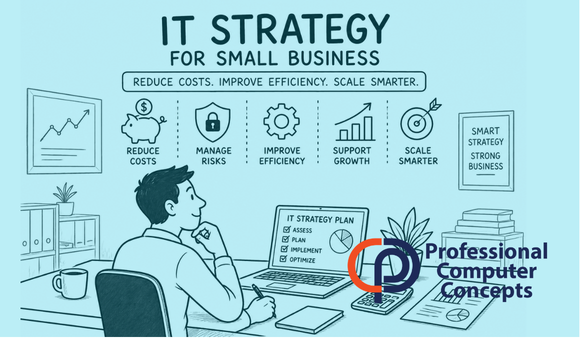
TL;DR A strong IT strategy for small business reduces costs by preventing problems, not reacting to them. Businesses that plan ahead spend less over time and scale more efficiently.
Many small businesses try to control IT costs by spending less. They delay upgrades, avoid long-term commitments, and fix issues only when they become urgent.
It feels practical in the moment.
Over time, it becomes expensive.
An effective IT strategy for small business is not about cutting costs. It’s about making smarter decisions that reduce waste, prevent disruptions, and support growth.
Cheap IT Often Becomes Expensive IT
Cutting corners in technology rarely saves money long-term. It usually shifts costs into less visible areas.
These costs show up as:
- Downtime that interrupts operations
- Emergency fixes that cost more than planned work
- Systems that don’t scale with the business
What looks like savings upfront often turns into higher total cost over time.
This pattern is common among businesses dealing with “technology challenges small businesses face”
Reactive Decisions Drive Unpredictable Costs
Without a plan, IT decisions are made under pressure. Something breaks, and the priority is to fix it as quickly as possible.
This leads to:
- Rushed decisions
- Short-term solutions
- Repeated issues
Costs become unpredictable because there is no structure guiding decisions.
A more effective approach is to shift from reactive fixes to planned improvements. If you’re evaluating your current approach, it’s worth reviewing “When Does a Small Business Need Managed IT Services?”
Downtime Is More Expensive Than Most Businesses Realize
Downtime is often underestimated because it is not always tracked clearly.
It impacts:
- Employee productivity
- Customer experience
- Revenue opportunities
Did You Know? According to the IBM Cost of a Data Breach Report, the financial impact of incidents and disruptions can be significant, especially for smaller organizations.
Preventing downtime is one of the most effective ways to reduce overall IT costs.
Security Incidents Create Hidden Financial Risk
Cybersecurity is often viewed as a separate concern from cost control. In reality, the two are closely connected.
A single incident can result in:
- Direct financial loss
- Recovery expenses
- Reputational damage
Addressing security as part of a broader strategy reduces these risks. If you haven’t evaluated your current approach, start with “The Small Business Guide to Cybersecurity”
Scalability Reduces Long-Term Costs
As businesses grow, their technology needs change. Without a strategy, scaling becomes inefficient.
Common issues include:
- Replacing systems too frequently
- Adding tools that don’t integrate
- Increasing complexity without improving outcomes
A well-defined IT strategy for small business focuses on solutions that can grow with the business, reducing the need for constant replacement and adjustment.
Strategy Creates Predictability
One of the most overlooked benefits of a strong IT strategy is predictability.
With a structured approach, businesses gain:
- Clear expectations around costs
- Fewer surprises
- Better planning for growth
For a broader look at how strategy connects across the business, refer to “Small Business Success in 2026: Technology, Security, and Growth Strategies That Actually Work”
What Businesses Gain from a Strategic Approach
An effective IT strategy for small business leads to:
- Lower long-term costs
- Improved efficiency
- Reduced risk
- Stronger support for growth
It changes technology from a source of frustration into a reliable foundation.
About Professional Computer Concepts
Professional Computer Concepts (PCC) is a trusted Managed IT and Cybersecurity provider serving the Bay Area for over 20 years. We help small and midsize businesses simplify their IT, strengthen security, and modernize operations. Explore our services:
Managed IT Services | Cybersecurity | Cloud Solutions
From PCC’s Desk
Trying to spend less on technology often leads to spending more.
A clear IT strategy for small business creates stability, reduces risk, and supports growth without unnecessary complexity.
If your current approach feels reactive or unpredictable, it may be time to look at the bigger picture. Let’s talk.