

You’re rushing to get dinner started after a long day. You ask your smart speaker to play a playlist for cooking, and it does—no questions asked. You get a reminder on your phone that your online grocery order is ready. Later, you scroll through social media and notice every ad seems eerily tailored to what you’ve been thinking about.
Whether you realize it or not, AI is part of your day from the moment you wake up to the moment you shut your eyes, and it’s not slowing down. But with all the buzzwords flying around—generative AI, agentic AI, machine learning—it’s easy to feel overwhelmed or unsure of what all of this really means.
That’s why we’ve put together the different types of AI explained in a way that makes sense, even if you don’t consider yourself tech-savvy. No jargon. No complicated diagrams. Just real-world examples, clear definitions, and an easy way to understand what AI is doing behind the scenes.

Understanding how AI actually works starts with having the different types of AI explained clearly, without the technical jargon.
What Is AI, Really?
AI stands for “artificial intelligence,” but that can make it sound more mysterious than it is. At its simplest, AI refers to computers doing tasks that normally require human intelligence. That might include recognizing your voice, predicting what movie you want to watch next, or even writing a poem.
If you’ve ever used a map app to get around traffic, spoken to a chatbot for help with an order, or gotten a “you might like this” suggestion from Netflix or Amazon, you’ve already used AI.
But AI is not one thing. It’s a broad category that includes many different tools, systems, and technologies. Some AIs are simple and reactive. Others can perform complex tasks on their own. Some generate content. Others quietly analyze massive amounts of data in the background.
The more we understand these different types of AI, the easier it is to recognize what they’re doing, what they’re good at, and where we need to be cautious. Explore in our blog “What is Artificial Intelligence Anyway?“
Did You Know?
According to IBM, over 35% of businesses already use AI in some form, and another 42% are exploring how to implement it.
(Source: IBM Global AI Adoption Index 2023)
Different Types of AI Explained
When people hear the term “AI,” they often think of a single, futuristic technology. But the truth is, artificial intelligence comes in many forms—each designed to do different things. Understanding these differences helps you recognize what AI is actually doing, what it’s capable of, and where its limits are.
In this blog, we’ve covered the different types of AI explained in a straightforward way:
-
Narrow AI handles one task at a time and powers the tools you already use daily.
-
Generative AI creates new content like text, images, or music.
-
Agentic AI can take actions, make decisions, and complete multi-step tasks with little to no help.
-
Reactive AI follows fixed rules, while Learning AI improves through experience.
Whether you’re running a business, managing a household, or just trying to stay current, understanding the different types of AI gives you more confidence in how you use technology—and how you protect yourself from its misuse.
Narrow AI: The Specialist
This is the most common type of AI in use today. Narrow AI is trained to do a single task—and it does that one thing very well. It might help sort your inbox, suggest music, or block spam calls.
But here’s the key: it doesn’t understand anything outside its job. A navigation app can give you directions, but it can’t answer a question about your calendar. A chatbot might know how to track your package, but it can’t write a recipe.
Generative AI: The Creator
Generative AI makes things. It creates new content based on patterns it has learned from huge amounts of data. That might be writing, images, music, code, or even voice.
ChatGPT, for example, can draft emails, summarize documents, or answer questions in a conversational way. Tools like DALL·E can generate realistic images based on a text prompt.
This is the type of AI behind many of today’s most buzzworthy tools—and it’s already transforming how people work, communicate, and create.
Did You Know?
Generative AI tools like ChatGPT reached 100 million users in just two months—faster than any platform in history.
(Source: UBS)
Agentic AI: The Doer
Agentic AI is more than reactive. It doesn’t just respond—it can act. You can give it a goal, and it figures out how to get there.
For example, instead of saying “Book me a hotel,” you might say, “Plan my whole trip to Seattle for next week.” An agentic AI might search for flights, compare hotels, check your calendar, and book the best options. It takes steps, adapts to changes, and handles complex tasks with minimal input from you.
This is the next big leap in AI—moving from helpful assistants to digital agents that can manage full processes.
Did You Know?
Gartner predicts that by 2026, over 80% of businesses will be using generative AI in production environments—many through agentic systems that operate across workflows.
(Source: Gartner, 2023)
Reactive vs. Learning AI
Another way to understand AI is by how it handles information:
-
Reactive AI responds to inputs using fixed rules. It doesn’t learn or improve over time. A basic chatbot that sticks to a script is an example of this.
-
Learning AI (also called Machine Learning) improves with use. The more data it processes, the better it gets. That’s how your email app gets smarter about flagging spam, or how voice assistants get better at understanding your voice.
Learning AI is the foundation for many of today’s most powerful tools—and it’s also what makes AI feel more “intelligent” over time.
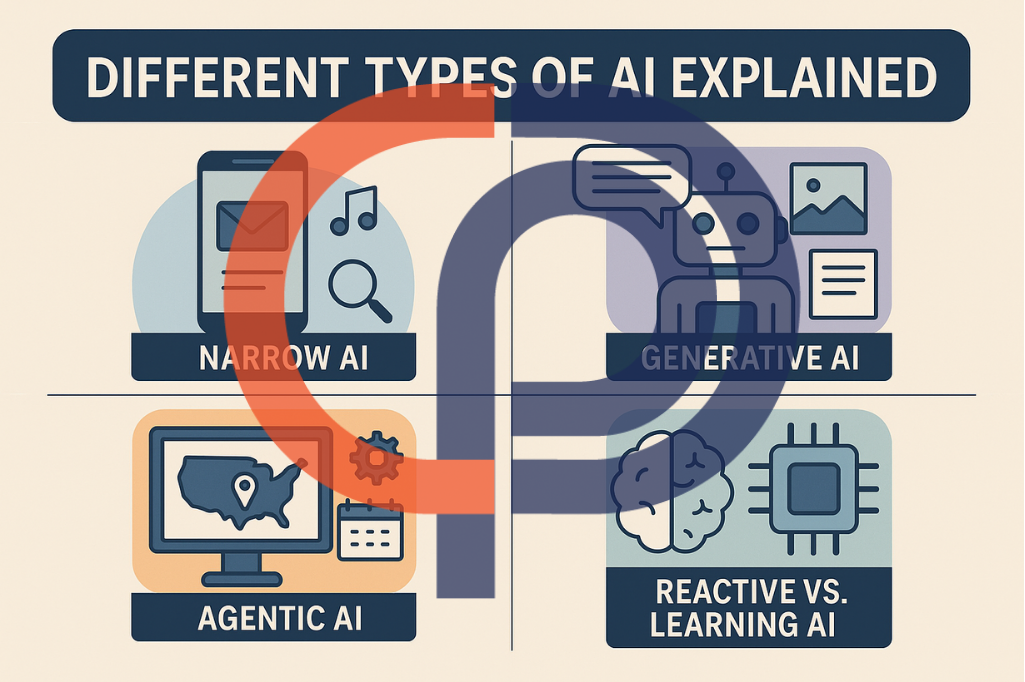
The different types of AI explained with real-world examples to help you spot them in your everyday life.
Why Should You Care?
You don’t need to be a software developer or tech enthusiast to care about AI. It’s already shaping how we live, work, shop, and communicate.
Businesses are using AI to respond to customers faster, identify trends, and simplify tasks that used to take hours. Employees use AI tools to draft documents, automate follow-ups, and summarize meetings. At home, people rely on AI to plan meals, build schedules, or generate creative ideas.
Understanding the different types of AI helps you spot the difference between useful tools and empty hype. It helps you make better decisions, protect your privacy, and get more out of the technology you already use.
And as AI continues to evolve, knowing what it can and can’t do becomes more important than ever. Explore how the future of AI is unfolding in the business world and what trends to keep an eye on.
Want to see how tools like Microsoft Copilot are already transforming how teams work? Explore our blog on Copilot here.
Final Thoughts
AI isn’t some distant, futuristic concept anymore. It’s here, woven into the apps we use, the emails we write, and even the way we make decisions. But it’s important to remember that AI isn’t just one thing. It’s a wide-ranging set of tools—some designed to assist with daily tasks, others built to create new content, and some that can take action on your behalf.
You don’t need to become a technology expert to keep up. But as these tools become more integrated into both work and life, it pays to understand the basics. Knowing how to spot the differences between types of AI helps you use them wisely. It helps you choose tools that actually make your job easier, not more confusing. And just as importantly, it helps you recognize when to pause, ask questions, and think critically before clicking or trusting something generated by a machine.
That kind of awareness matters—especially now that some AI tools are being used in harmful ways. Phishing emails powered by AI can sound more convincing than ever, making it even harder to tell what’s real and what’s a trap.
Some AI tools are even being used to launch more convincing phishing attacks.
If you’re feeling curious, cautious, or maybe even a bit overwhelmed, that’s okay. You’re not alone.
What is artificial intelligence anyway? If you’ve been wondering that exact thing, we broke it down in another beginner-friendly guide.
AI for small business IT is already making IT support faster, smarter, and more accessible—and that’s just one example of how it’s reshaping industries.
Embracing artificial intelligence in your business starts with understanding what tools are available—and how to prepare for what’s next.
The key is to stay informed, stay grounded, and stay open to possibility.
How Professional Computer Concepts Can Help
At Professional Computer Concepts, we believe technology should work for you not the other way around. Our goal is to help you take advantage of tools like AI without getting lost in the complexity or risking your security.
Whether you’re thinking about using AI to streamline operations, improve customer communication, or just get more organized, we can help you make decisions that are smart, safe, and aligned with your goals.
Not sure where to begin? Our beginner’s guide to ChatGPT is a great starting point for exploring one of the most popular AI tools available.
Already experimenting with multiple tools? We also cover how Claude AI compares to ChatGPT—so you can choose what fits best.
We cut through the noise and guide you toward practical solutions that actually make a difference in your business.
For over 20 years, we’ve partnered with small and mid-sized businesses across the Bay Area to provide reliable IT support, modern security solutions, and clear advice you can trust. We don’t just fix what’s broken—we put systems in place to help you grow confidently.
If you’re wondering how AI fits into your business or how to use it responsibly, let’s start a conversation. We’re here to help you move forward with clarity, confidence, and the right support behind you. Let’s talk!