

TL;DR If your systems feel harder to manage, issues keep coming back, or growth creates friction, your business has likely outgrown its IT setup. The solution isn’t more tools. It’s better structure, ownership, and alignment.
Most businesses don’t make a clear decision to invest in IT support. They drift into it. Over time, many find themselves operating in an outgrown IT setup small business environment without realizing it.
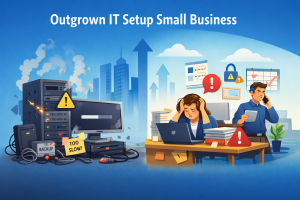
Many companies operating with an outgrown IT setup small business environment experience more downtime and security gaps.
Over time, systems become harder to manage, small issues pile up, and processes that once worked start slowing things down. Nothing fully breaks, but nothing feels efficient either.
That’s usually the moment an outgrown IT setup small business environment starts affecting daily operations.
If you’re wondering whether you’ve outgrown your IT setup as a small business, the answer is rarely obvious. It shows up in subtle ways first, then gradually starts affecting how your business operates day to day.
Did You Know? Many companies operating with an outgrown IT setup small business environment experience more downtime and security gaps because their systems were never designed to scale with growth.
The Problem Isn’t Always Obvious
Technology rarely fails all at once.
What actually happens is slower and harder to detect. Small inefficiencies start to compound. Workarounds become normal. One person ends up holding too much knowledge about how things function.
Decisions get delayed because changing anything feels risky.
Individually, these don’t seem urgent. Together, they create operational drag that impacts productivity, security, and growth.
Common Signs of an Outgrown IT Setup Small Business Environment

Outgrown IT Setup Small Business Environment
The signals are usually consistent across businesses.
Issues get resolved temporarily, but they come back. Systems don’t integrate cleanly, which leads to manual processes and duplicated work. Responsibility for IT is unclear, often spread across employees or vendors without real ownership.
Security becomes a question mark instead of a defined strategy.
And as the business grows, everything becomes more complicated instead of more efficient.
These patterns are common in any outgrown IT setup small business environment where systems haven’t kept pace with growth.
If this sounds familiar, you’re not dealing with isolated problems. You’re dealing with a structural issue.
Why Businesses Stay in This Stage Too Long
Most companies recognize something isn’t working, but they delay addressing it.
Part of it is psychological. If systems still function, even poorly, it doesn’t feel urgent. There’s also a real concern about disruption. Changing IT systems sounds risky, time-consuming, and expensive.
There’s also a lack of clarity. Many business owners don’t know what “good” actually looks like when it comes to IT structure.
We see this often with small businesses in cities like Novato and Concord. The environment moves quickly, expectations are high, and teams adapt around inefficient systems longer than they should simply to keep things running.
Many businesses continue operating in an outgrown IT setup small business environment longer than they should because the problems build gradually instead of all at once.
What Changes When IT Is Structured Properly
When IT is aligned with how a business operates, the difference is noticeable.
Issues are resolved at the root instead of patched repeatedly. Systems are standardized, which reduces complexity. Security is actively managed instead of assumed.
Employees spend less time dealing with technology problems and more time doing their actual work.
Growth stops creating friction and starts becoming easier to support.
This is the shift from reactive support to structured IT management.
If you’re starting to see these patterns, it helps to understand what IT support for small businesses in the Bay Area should actually look like and how it’s structured to support growth.
Moving away from an outgrown IT setup small business environment allows systems to support growth instead of slowing it down.
The Risk of Waiting
The biggest risk isn’t a major outage. It’s the accumulation of small inefficiencies over time.
Lost productivity, increased exposure to security threats, and rising costs from reactive fixes all build quietly in the background. These issues tend to surface at the worst possible time, often during periods of growth or change.
Did You Know? According to IBM’s Cost of a Data Breach Report, the average cost of a breach reached $4.88 million globally. [Source: IBM Security]
Most of these risks are preventable, but only if they’re addressed early.
What to Do Next
If your business is showing these signs, the next step isn’t to add more tools. It’s to step back and evaluate how your environment is structured.
That means understanding what’s working, what isn’t, where the risks are, and what needs to change to support the next stage of growth.
A good starting point is reviewing how your current setup compares to a structured approach like managed IT services, where systems, security, and support are aligned under a single strategy.
For a deeper look, read:
- The Small Business Guide to Cybersecurity
- What to Expect from a Managed IT Provider
- How Outsourced IT Support Helps Small Businesses Save Money and Grow
About Professional Computer Concepts
Professional Computer Concepts (PCC) is a trusted Managed IT and Cybersecurity provider serving the Bay Area for over 20 years. We help small and midsize businesses simplify their IT, strengthen security, and modernize operations. Explore our services:
Managed IT Services | Cybersecurity | Cloud Solutions
From PCC’s Desk
Outgrowing your IT setup is a sign your business is moving forward.
Ignoring it is what creates problems.
Most companies operating in an outgrown IT setup small business environment don’t need more technology. They need better alignment between their systems and how they operate.
If you’re unsure where your environment stands, start with a conversation.
Let’s talk. We’d love to hear from you.
Frequently Asked Questions
How do I know if my small business has outgrown IT setup small business environment?
If your systems feel harder to manage, issues keep recurring, or adding employees creates more problems instead of efficiency, your business has likely outgrown its IT setup. These are signs that your technology is no longer aligned with how your business operates.
What happens if I don’t upgrade my IT setup?
Delaying changes usually leads to increased inefficiencies, higher support costs, and greater security risks. Over time, small issues compound and can disrupt operations, especially during periods of growth.
Is it better to fix issues as they come up or invest in IT support?
Fixing issues as they come up may seem cost-effective, but it often leads to repeated problems and higher long-term costs. Structured IT support focuses on resolving root causes and preventing issues before they impact your business.
What does a properly structured IT environment look like?
A well-structured IT environment includes standardized systems, clear ownership, proactive maintenance, and defined security practices. It supports your business growth instead of slowing it down.
Do small businesses really need managed IT services?
Most small businesses don’t need more technology, but they do need better organization and support. Managed IT services help align systems, improve security, and reduce downtime, especially as the business grows.
When should I consider IT support for my business?
If you’re experiencing recurring issues, unclear responsibility for IT, or growing complexity, it’s time to evaluate your setup. Businesses in high-demand areas like Novato and San Francisco often reach this point faster due to growth and operational demands.
What causes an outgrown IT setup small business environment?
This typically happens when a business grows faster than its technology strategy. Systems are added over time without structure, leading to inefficiencies, security gaps, and lack of ownership.