
Phishing is still the most common way cybercriminals break into businesses—and it’s not just big corporations being targeted. Small and mid-sized businesses are especially vulnerable because attackers count on one thing: human error.
That’s where phishing security awareness training comes in. And when paired with realistic phishing simulations, it becomes one of the most effective ways to protect your business from credential theft, ransomware, and email compromise.
This guide breaks down everything you need to know: what phishing really looks like in 2025, what security awareness training involves, how phishing simulations work, and how you can combine them to reduce risk across your organization.

What Is Phishing—and Why Is It So Effective?
Phishing uses fake emails, messages, or websites to trick users into giving up passwords, financial info, or access to business systems. In 2025, AI-generated phishing emails are more convincing than ever—and attackers are constantly adapting.
Phishing can lead to:
-
Credential theft used in further attacks
📖 Learn more: Phishing 2.0: The Rise of AI-Driven Attacks
📖 Also read: How to Prevent Phishing Attacks
“The human element is the weakest link in security, but with effective phishing security awareness training, employees can become the strongest defense against phishing and social engineering attacks.
What Is Security Awareness Training (SAT)?
Security Awareness Training educates employees on how to recognize and respond to cyber threats—especially phishing. It covers:
-
How to spot phishing red flags
-
(also read: How to Spot a Phishing Email)
-
-
Password best practices
-
(also read: What does it really meant to use strong password)
-
-
Email safety
-
Social engineering tactics
-
What to do if a suspicious message is received
SAT can be delivered through:
-
Interactive modules
-
Quizzes and videos
-
Newsletters or lunch-and-learns
-
Targeted content for different roles (e.g., finance vs admin)
📖 Dive deeper: Empower Yourself with Security Awareness Training
📖 And: Building a Culture of Awareness
Organizations that implement phishing security awareness training and simulated phishing tests have seen employee susceptibility drop from 32.4% to just 5.4% in one year—an 80% reduction in risky behavior. Ongoing training and testing significantly strengthen your workforce’s resilience against phishing threats.
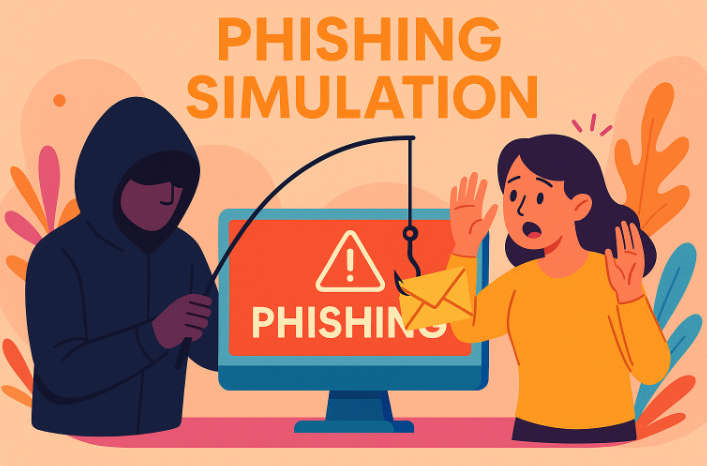
Phishing security awareness training with simulations creates a measurable, proactive approach to cybersecurity.
What Are Phishing Simulations?
Phishing simulations are controlled tests that send fake phishing emails to employees. They’re not real threats—but they feel real. The goal is to see who clicks, who reports, and who might need extra training.
Key benefits:
-
Reinforces training with experience
-
Identifies at-risk users
-
Tracks behavioral improvement over time
📖 See examples in action: Real-Life Phishing Scenarios: Train Your Team with Examples
SAT vs Phishing Simulation: What’s the Difference?
Think of SAT as the lesson—and simulation as the pop quiz. You need both.
| SAT | Phishing Simulation |
|---|---|
| Teaches recognition | Tests real-world behavior |
| Covers multiple threat types | Focuses on phishing |
| Periodic or role-based | Random and recurring |
| Builds awareness | Builds instincts |
📖 Compare in depth: SAT vs Phishing Simulation: What’s the Difference?
Phishing security awareness training cultivates a security-first mindset that prioritizes data protection and network security, effectively supporting human risk management. It does this by providing employees with the knowledge and tools they need to combat phishing attacks. Carefully designed programs teach users how to detect and react to threats so that they can help protect sensitive data, rather than being considered an easy way into an organizations network.
How to Measure Success: Metrics That Matter
To know if your program is working, track these phishing training metrics:
-
Click rate: how many users clicked the simulation
-
Report rate: how many users flagged the email
-
Repeat offenders: who continues to fall for it
-
Time to report: how quickly users act
📖 Full guide: How to Measure the Success of Your Phishing Awareness Program
What Happens When You Get It Right?
A strong phishing security awareness program can:
-
Stop breaches before they happen
-
Reduce risk of ransomware and fraud
-
Strengthen your cyber insurance eligibility
-
Build a culture where security is second nature
Training your team doesn’t just check a box—it protects your business’s reputation, continuity, and client trust.
How Professional Computer Concepts Helps You Put It All Together
At Professional Computer Concepts, we specialize in helping small and mid-sized businesses build phishing security awareness programs that actually work. We don’t just send training videos and walk away—we deliver:
-
Role-based SAT programs customized to your risk profile
-
Realistic phishing simulations with detailed click and report tracking
-
Remediation coaching for high-risk users
-
Metrics dashboards to track improvement over time
-
Full integration with Microsoft 365 and Google Workspace
-
Ongoing cybersecurity services including dark web monitoring, endpoint protection, and vCIO guidance
Whether you’re in legal, construction, manufacturing, or professional services, we understand your industry’s threats—and how to build a team that can spot them.
📌 Ready to start? Let’s talk about strengthening your team’s first line of defense.
Read some related articles:
- Common Cyberattacks Explained
-
How Ransomware Spreads in Small Businesses—and How to Stop It
-
Cybersecurity Awareness Training for Small Businesses: Why It’s Critical
-
What Is Cyber Hygiene? A Practical Guide for Small and Mid-Sized Businesses
-
Phishing Awareness for Employees: Why New Hires Are Prime Targets