 Strong Security Is More Than Just Antivirus
Today’s threats are more sophisticated than ever, and small businesses are increasingly in the crosshairs. Staying safe isn’t just about having antivirus software, it’s about deploying the right combination of cybersecurity tools and technologies that work together to protect your systems, data, and users.
Cybercriminals don’t just rely on viruses anymore. We recently wrote an article on how antivirus alone just isn’t enough anymore. Cybercriminals use phishing attacks, exploit unpatched software, and trick users into handing over credentials. That’s why businesses need layered protection that goes beyond the basics.
Think you are too small to be hacked? Think again.
What Belongs in a Strong Cybersecurity Stack?
A modern security stack includes tools that detect, respond to, and recover from threats—ideally before your data or systems are compromised.
Endpoint and Network Threat Detection
At the core of every strong security strategy are tools like Endpoint Detection and Response (EDR) and Managed Detection and Response (MDR). EDR helps detect malicious activity at the device level, while MDR adds 24/7 human-backed threat analysis and response. Combined, they dramatically reduce the time it takes to catch and contain threats. Learn how we helped a business rebuild after a ransomware attack in Revitalizing IT After a Ransomware Attack.
Identity Protection and Access Control
Multi-Factor Authentication (MFA) remains one of the simplest and most effective defenses against stolen credentials. When paired with strong password policies and identity management tools, it can block a majority of account takeover attempts. If you’re still unclear about what MFA does, check out Unlocking the Power of MFA and The Difference Between 2FA and MFA.
Prevention Through Filtering and Patching
Firewalls, email filtering, and patch management systems also play critical roles. They prevent malware from getting in, stop employees from clicking dangerous links, and ensure known vulnerabilities are closed before attackers can exploit them. We explore phishing prevention further in Phishing Awareness for Employees: What Every Business Needs to Train On.
Recovery and Business Continuity
Backup and recovery tools round out the stack. They ensure that even if an attack gets through, you can recover your data without paying a ransom. Ransomware is still a major threat, and we break it down in How Ransomware Spreads in Small Businesses.
Trends in Cybersecurity Tools and Technologies
 The market for cybersecurity tools and technologies is booming—and it’s not just big business driving growth. In 2025, global cybersecurity spending is expected to hit $212 billion, while cybercrime costs are projected to reach $10.5 trillion annually. As threats grow more sophisticated, businesses of all sizes are investing in smarter tools that offer real-time visibility, automation, and layered protection.
By 2025, 65% of enterprises worldwide will have adopted advanced cybersecurity tools and technologies—up from just 45% in 2020. North America leads global adoption at 75%, followed by Europe (60%) and Asia-Pacific (50%). Industry-specific adoption is also accelerating:
-
Finance: 85%
-
Healthcare: 70%
-
Retail/E-commerce: 60%
-
Education: 55%
-
Manufacturing: 50%
These adoption rates reflect the growing recognition that traditional defenses are no longer enough. Industries that handle sensitive data, like finance and healthcare, are turning to cybersecurity tools and technologies that offer deeper insights, better user protection, and faster response.
Check out a related blog: Small Business Cybersecurity Guide
What Businesses Are Prioritizing in 2025
Organizations are rethinking their approach to cybersecurity. In 2025, key priorities include:
-
AI and Machine Learning: 66% of companies say AI is the most impactful factor in their cybersecurity strategy.
-
Zero Trust Architecture: Security built on identity and access rather than network location.
-
Privileged Access Management (PAM): Now essential for reducing insider threats.
-
Multi-Factor Authentication (MFA): Accelerating in adoption due to its effectiveness.
-
Cloud Security: As businesses migrate to cloud platforms, protecting cloud environments is a top concern—especially in finance and healthcare.
These shifts all point to one thing: cybersecurity isn’t a static checklist. The tools and technologies you use must evolve alongside the threats.
The Talent Gap and Why the Right Tools Matter
Even with rising investment, there’s a serious shortage of cybersecurity talent. Only 14% of organizations feel confident in their internal team’s readiness, and two-thirds report a widening skills gap.
The average time to detect a breach is still 194 days, with a 277-day breach lifecycle. That is long enough to cause serious harm. That’s why the right cybersecurity tools and technologies aren’t just nice to have, but they’re essential for early detection, incident response, and operational resilience.
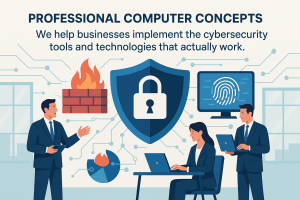 Choosing the Right Tools for Your Business
Not every business needs enterprise-level solutions, but every business does need a strategy. The right cybersecurity tools and technologies should match your risks, your industry, and your budget. A construction firm with remote field staff has different needs than a law office with sensitive client data.
At Professional Computer Concepts, we don’t just install tools—we design layered systems of protection using the right cybersecurity tools and technologies for your business. We provide complete managed protection that evolves with your business.
If you’re not sure what your current tools are doing—or not doing—we can help you figure it out. Let’s make your cybersecurity work as hard as you do.
Ready to review your cybersecurity stack? Let’s talk about how to strengthen your defenses.